The Ultimate South African Braai Guide
Everything that makes a braai work, from building the fire and timing the meat to the braaimaster's unwritten rules, plus how braais differ from the Cape to KwaZulu-Natal.
 The Stompies teamUpdated 23 min read
In this article
- 1What Is a South African Braai?
- 2The Cultural Heart of the South African Braai
- 3Essential Braai Equipment and Setup
- 4Traditional South African Braai Foods
- 5Mastering Fire Management and Cooking Techniques
- 6Braai Etiquette and Traditions
- 7Planning Your Perfect Braai
- 8Common Braai Mistakes to Avoid
- 9Regional Braai Variations Across South Africa
- 10Embracing the Spirit of the Flame
The crackling of wood, the smoky scent of meat sizzling on a grid, and the laughter of friends echoing under the African sun capture the very soul of a South African braai.
It is far more than just a way to cook food; it is a cherished ritual that binds people together through fire, flavour, and fellowship.
The braai is a living expression of what it means to be South African, uniting families, friends, and strangers in a shared celebration of life and culture.
This ultimate guide takes you deep into the heart of the South African braai tradition.
You will discover not only the essential techniques for cooking over open flames but also the rich stories, history, and meaning that make every braai unforgettable.

Whether you are a lifelong local or a curious newcomer, this journey will show you how to create the perfect braai experience that feels authentic, warm, and truly South African.
To master the art of the ultimate braai, one must understand that every great fire is the foundation of a great feast.
Few names are as trusted as Stompies, whose sustainably sourced Namibian hardwoods, premium charcoal, and quality firelighters make it easier than ever to start strong and braai right.
What Is a South African Braai?
A South African braai is far more than a simple barbecue.
It is a cultural ceremony, a social event, and a gathering that celebrates life, unity, and flavour.
The word “braai” comes from the Dutch word “braden,” meaning “to roast,” but its spirit has evolved into something uniquely South African.
It is the sound of crackling coals, the aroma of wood smoke, and the laughter of people gathered together under an open sky.
The essence of the braai lies in its simplicity: fire, meat, and companionship.
Yet beneath that simplicity runs centuries of tradition deeply rooted in South African culture.
Long before modern grills, indigenous communities were cooking over open flames and sharing food as an act of unity that transcends cultural lines.
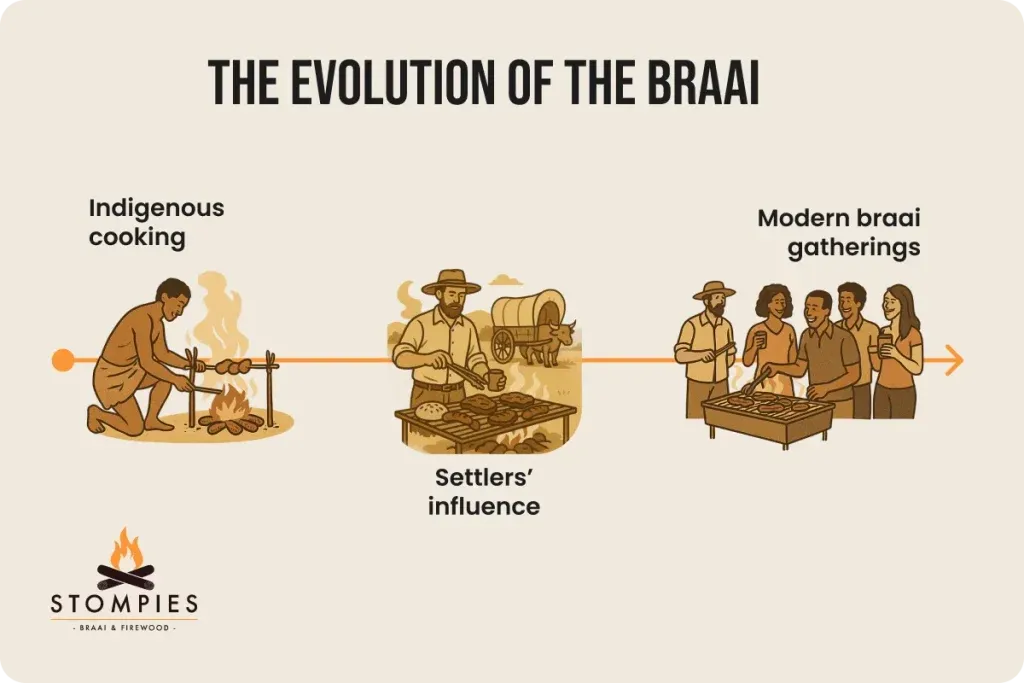
When settlers arrived, the practice evolved into the braai we know today: a beautiful blend of heritage, hospitality, and heart.
Unlike quick, gas-fuelled grilling, an authentic braai rewards patience and heat control.
It begins with building a fire from quality local wood, waiting as it burns down into perfect coals, and cooking each cut of meat in rhythm with the fire’s heartbeat.
The Braaimaster, keeper of the flame, is both host and artist, orchestrating the experience with care and pride.
To become a Braaimaster is a rite of passage, earned through patience, laughter, and the occasional trial by fire.
The fire is sacred.
It shapes flavour, warmth, and memory.
Every log matters.
South Africans know that real taste starts with the wood.
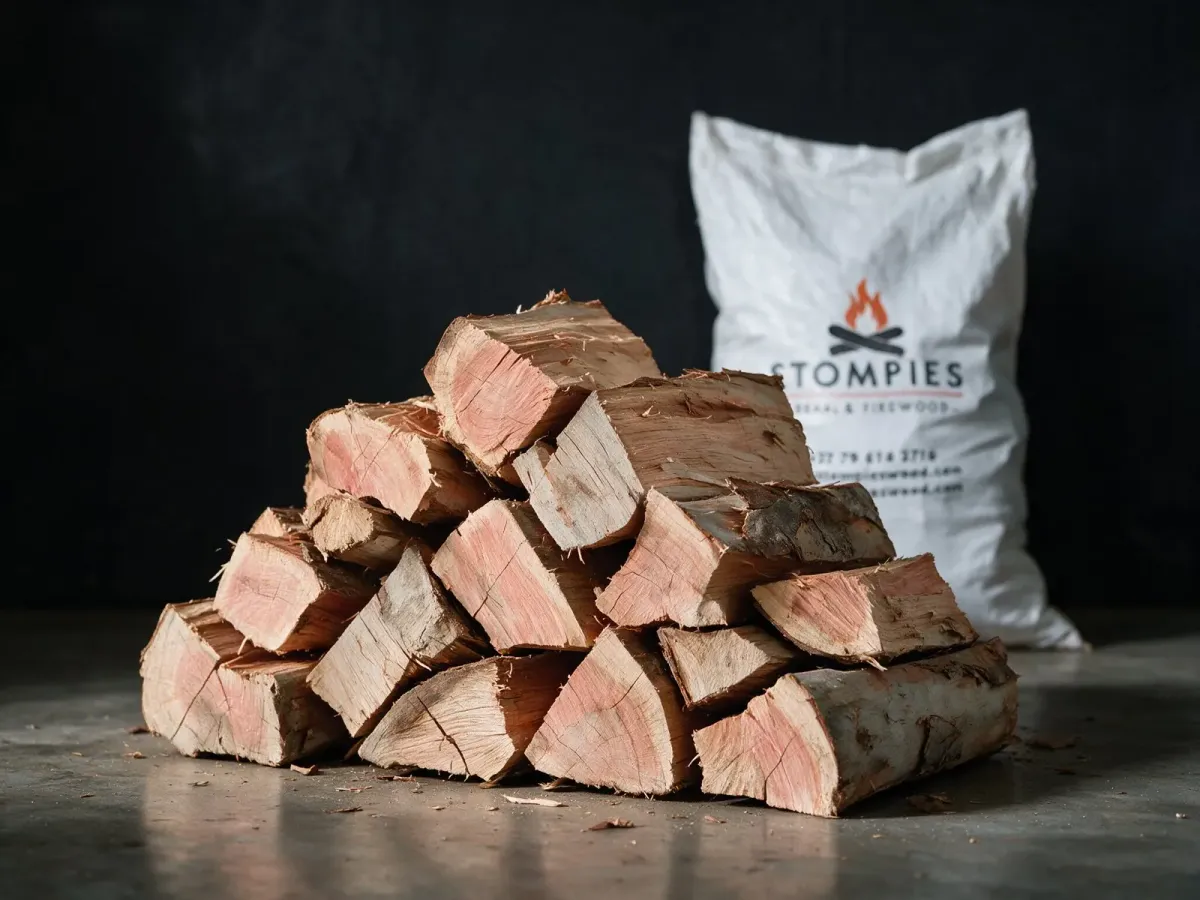
Hardwoods such as Kameeldoring, Sekelbos, and Rooikrans are the heart of true braai cooking.
Stompies’ selection of Kameeldoring Braai Wood and Sekelbos Braai Wood provides slow-burning, aromatic coals that deliver consistent heat and rich flavour.
Each fire you build connects you not only to the food but also to the generations who stood before their fires and shared their stories.
| Wood Type | Burn Time | Ideal For | Notes |
|---|---|---|---|
| Sekelbos | Long 🔥🔥🔥 | Any fireplace, braais | Balanced, aromatic |
| Blue Gum (Bloekom) | Medium 🔥🔥 | Closed fireplaces, pizza ovens | Needs seasoning |
| Black Wattle | Medium 🔥🔥 | Small rooms, indoor use | Clean burn, subtle flavour |
| Rooikrans | Medium 🔥🔥 | Braais, open fires | Lights fast, quick coals |
| Kameeldoring | Very Long 🔥🔥🔥🔥 | Open fires, braais | Extremely hot; use cautiously |
To braai is to connect.
It is where people gather without pretense or pressure, where the fire becomes the evening’s storyteller.
Whether in a township courtyard, a suburban garden, or beside a mountain stream or campsite, the ritual is the same.
The moment the first spark catches, you are part of something timeless.
The Cultural Heart of the South African Braai
At its core, the braai embodies Ubuntu: the African philosophy that says, “I am because we are.”
It is not just a meal but an act of community, where the fire becomes the centre of laughter, conversation, and shared humanity.
In South Africa, the braai transcends background, age, and status.
It happens in the wealthiest suburbs and the most modest villages, by the ocean or deep in the Karoo.
It is where everyone is equal before the fire, where stories flow as freely as the drinks, and the flames reflect in the eyes of friends.
Every September 24th, the nation celebrates Heritage Day, now lovingly known as National Braai Day.
On that day, millions of fires burn at once across the country.
Families light their coals, neighbours share platters, and strangers wave greetings over fences.
The air fills with the smell of wood smoke and spiced meat, and the whole country becomes one giant community feast.
It is a day that reminds everyone that despite differences, South Africans are united by the warmth of a shared flame.
Across the provinces, local influences give each braai its own flair.
In KwaZulu-Natal, spices dance through marinades and dry rubs.
In the Western Cape, curry-scented sosaties fill the air.
In the Free State, the focus is on slow-cooked, hearty bigger cuts of meat.
The fire, however, is always constant: the link between heritage and home.
A great braai is built on good wood, and Stompies understands that connection.
Their sustainably harvested hardwoods, such as Rooikrans and Bloekom (Blue Gum), bring both authenticity and environmental responsibility to your fire.
The dense coals they produce allow for even cooking, while their aroma adds that unmistakable South African scent that says, “home.”
When people talk about the heart of the braai, they are not speaking only of fire.
They are speaking of memory: the laughter that lingers, the stories that grow with each retelling, and the bonds strengthened by shared meals under the stars.
It is not the food that makes the braai sacred rather the people gathered around it.
Essential Braai Equipment and Setup
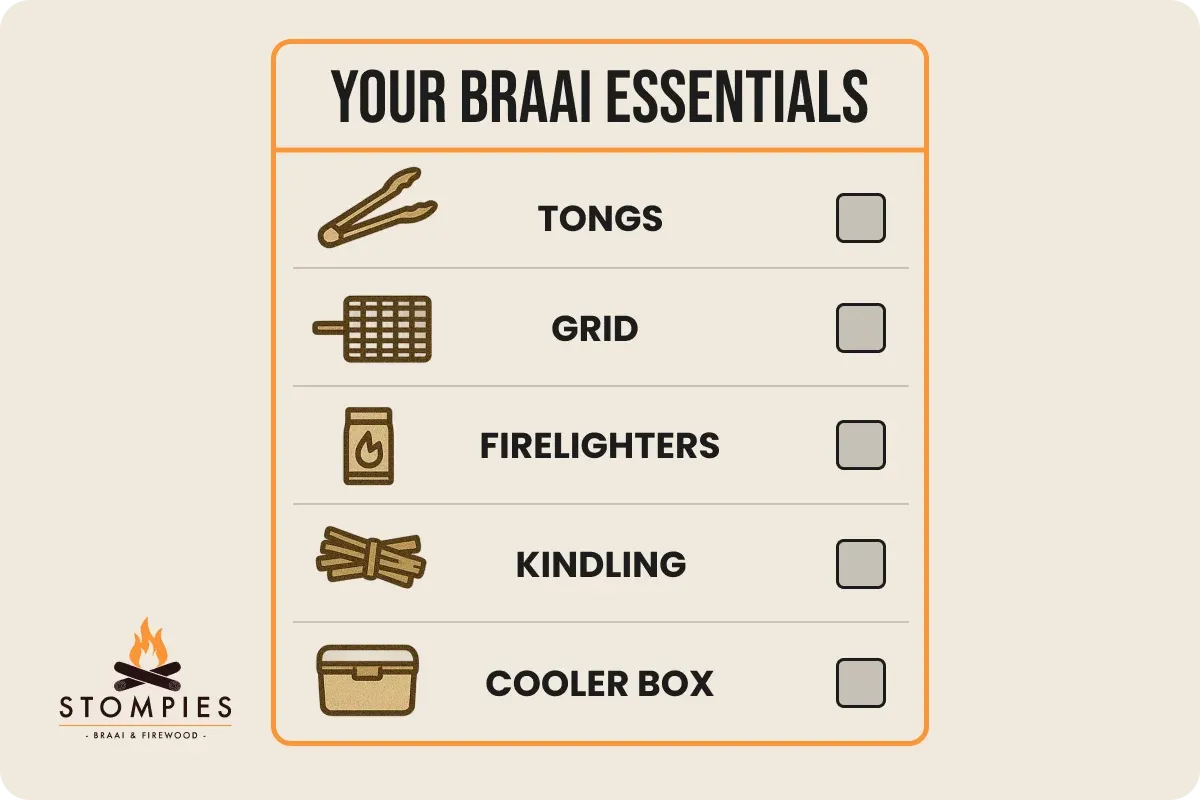
A true braai needs no excess.
All you really need is good wood, a grid, and a group of hungry people.
Yet a few essential braai accessories and the right setup can transform your experience from ordinary to exceptional.
The Right Fuel
Fuel is the foundation of every braai.
The type of wood or charcoal you use determines not just the heat but the character of your food.
Traditionalists swear by hardwoods because of their long-lasting burn and rich aroma.
Kameeldoring and Sekelbos burn hot and clean, and Rooikrans lights fast; all three produce the deep, glowing coals that define authentic braai flavour.
Stompies’ range of Namibian hardwoods offers exactly that balance: dense, dry, and perfectly seasoned.
Their wood burns evenly, produces minimal ash, and fills the air with a warm, earthy fragrance that complements any meat.
For quicker preparation or urban settings, Stompies’ Braai Charcoal and Braai Briquettes provide consistent heat without losing the soul of a traditional fire.
Briquettes burn longer and offer steady heat control, ideal for cooking meat evenly.
Tools of the Trade
Every Braaimaster has their favourite set of tools, and over time, each becomes an extension of their hand.
A sturdy pair of long-handled tongs, a well-built grid with adjustable height, and a reliable basting brush are essential.
Skewers for sosaties, a cast-iron potjie pot for stews, and a poker for adjusting coals complete the basic set of braai accessories.
Lighting and Safety
Starting your fire is part of the ceremony.
Patience and method make all the difference.
Begin with smaller kindling, then build upward using medium pieces before adding larger logs.
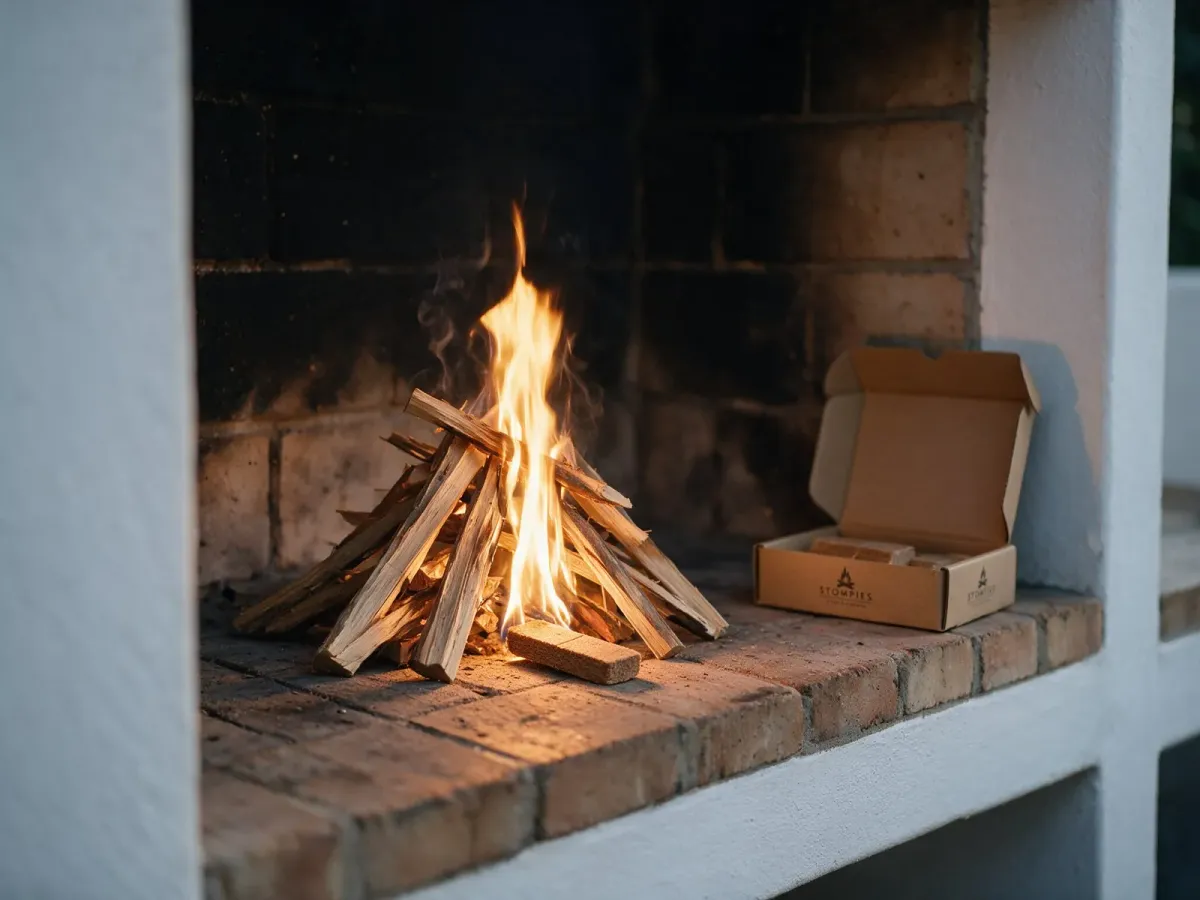
Use Stompies Eco Firelighters or Black Wattle Kindling for a clean quick start.
No fumes, no chemicals, just pure flame.
Allow the fire to breathe, and resist the urge to cook too soon.
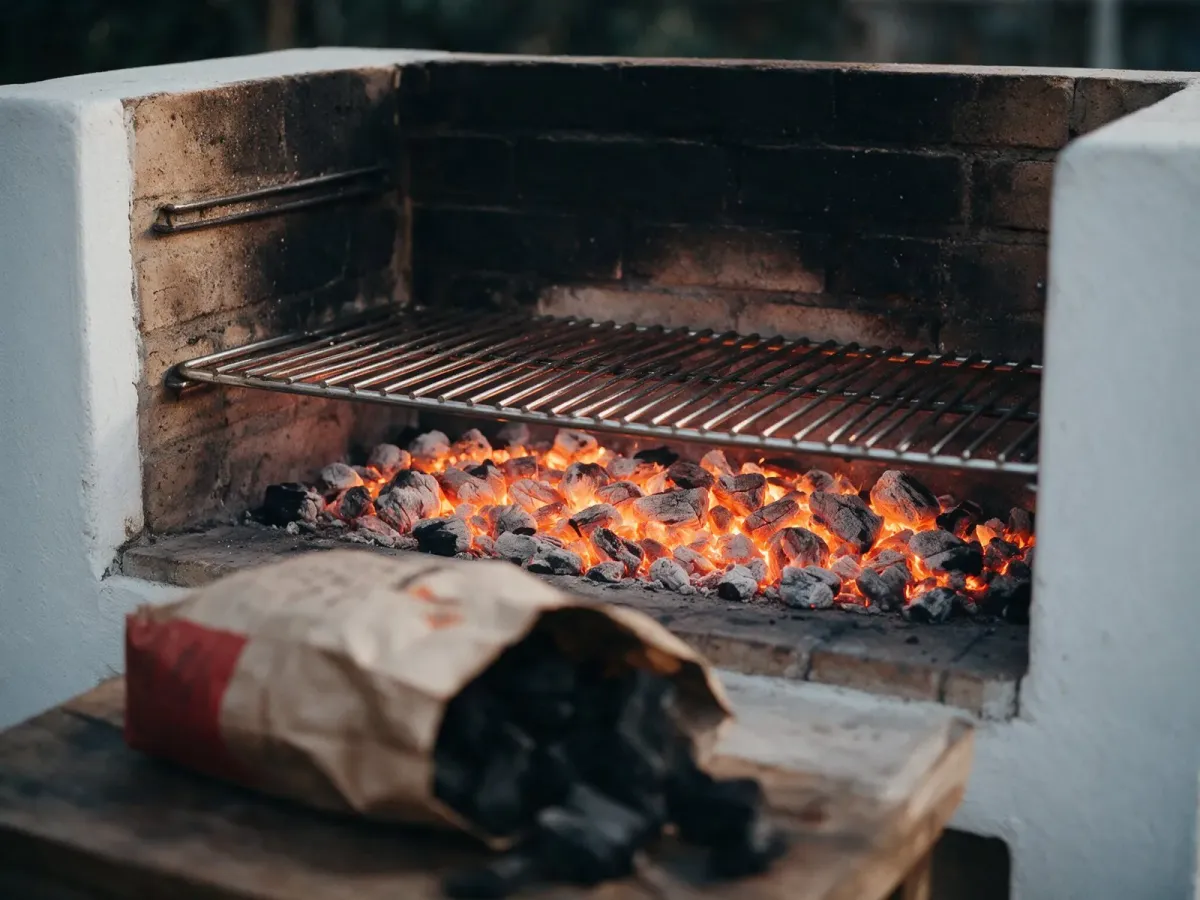
Wait until the flames settle into glowing red coals dusted with ash.
Always prioritize safety: keep a bucket of sand or water nearby, and make sure the braai is on stable, open ground away from overhanging branches.
When the meal is done, let the fire die naturally or cover it with sand until no embers remain.
Creating the Atmosphere
A perfect braai is as much about feeling as it is about food.
Arrange the seating close enough for warmth and conversation but with room to move.
Soft lighting, whether from lanterns, candles, or the glow of the fire itself, sets the tone.
Music is optional but often irresistible, from old kwaito classics to laid-back jazz.
The goal is not performance but presence (laughter, shared stories) and the smell of meat turning on the coals.
Traditional South African Braai Foods
If the fire is the soul of the braai, the food is its heartbeat.
South African braai cuisine is a joyful reflection of the country’s diversity.
Flavours are drawn from indigenous traditions, European settlers, and Asian influences, all harmonized by the unifying element of fire.
The Meats That Matter
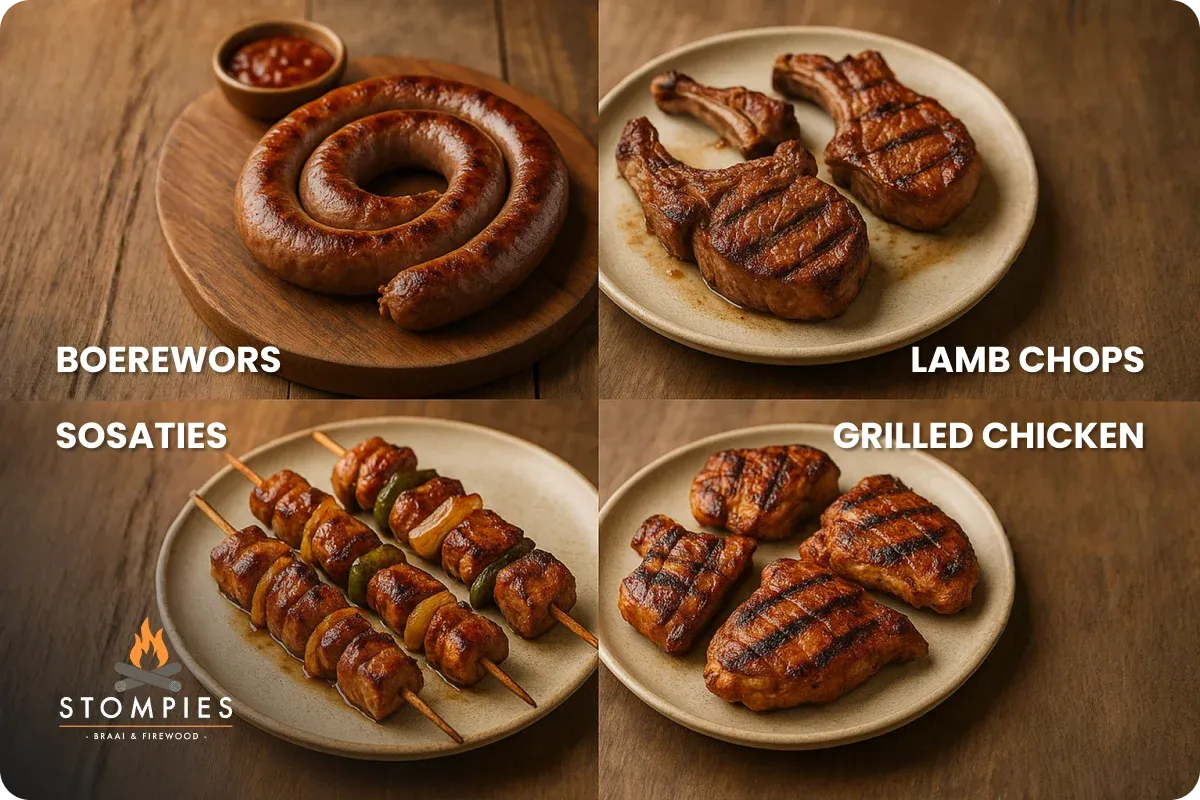
- Boerewors is the undisputed king. This coiled sausage, made from beef and pork, is seasoned with coriander, nutmeg, and clove, then cooked slowly over medium coals until the casing crisps and the juices run clear. The smell of boerewors sizzling on the grid is enough to call a neighbourhood together.
- Lamb chops are next in line. Their natural fat renders beautifully, crackling to a golden crust while the interior stays tender. A sprinkle of salt and pepper, a hint of rosemary, and steady heat from Stompies Sekelbos coals turn them into perfection.
- Steaks, especially T-bone and ribeye, deserve the hottest coals. Let them sear until char marks form, then rest before slicing. The subtle smokiness from Kameeldoring wood enhances the meat’s richness in a way no gas grill can replicate.
- Chicken, whether marinated in lemon, herbs, or peri-peri, benefits from moderate heat and time. The even burn of Stompies Briquettes makes it easy to achieve golden skin without burning the outside. Whole chickens can also be cooked slowly over steady heat for juicy results. And for those who crave something different, sosaties bring colour and Cape Malay spice to the grid.
Cubes of lamb or beef are marinated with onions, apricots, and curry, threaded on skewers, and grilled until the edges caramelize.
Even game meats like springbok or kudu find their place on the fire.
Their lean texture and wild flavour pair beautifully with a light olive oil marinade and the subtle smokiness of Rooikrans wood.
Traditional Braai Sides
A South African braai is never complete without its iconic sides.
These dishes turn a simple meal into a full-blown celebration.
They balance the smokiness of the meat with freshness, spice, and texture, each one adding its own voice to the table.
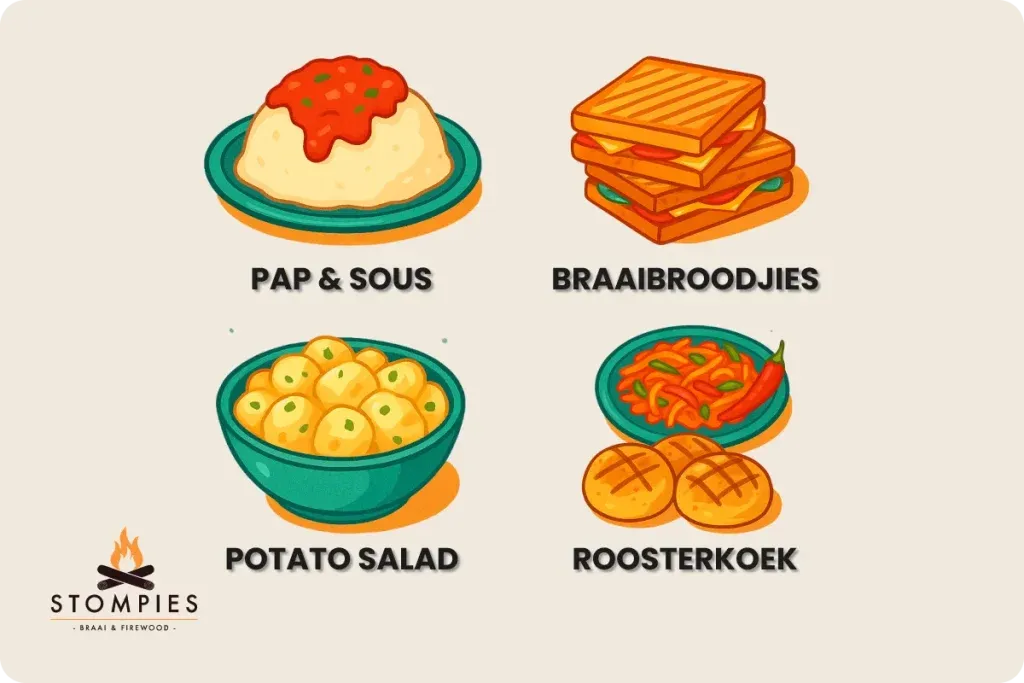
- Pap and Sous sit at the foundation of traditional braai culture. Pap, a smooth maize porridge, has been part of African cuisine for centuries. It is simple yet comforting, made from finely ground maize meal cooked slowly until it forms a firm, fluffy texture. The accompanying sous, a tomato-onion relish, cuts through the richness of grilled meat with its bright acidity. The combination is rustic perfection: one bite of smoky meat followed by a spoonful of pap and sous creates harmony on the plate.
- Braaibroodjies are the South African answer to the grilled cheese sandwich. Two slices of bread are layered with tomato, onion, and cheese, brushed with butter, and placed on the edge of the grill until the bread turns golden and the cheese melts into delicious gooeyness. Some families add chutney or herbs for extra flavour, while others keep it simple. Either way, they are often the first things to disappear from the grid.
- Potato Salad brings a creamy contrast to the smoky heat. The traditional version features boiled potatoes mixed with mayonnaise, eggs, and fresh herbs. In KwaZulu-Natal, curry powder adds a gentle kick, while coastal regions often include chopped pickles or green peppers for extra crunch.
- Chakalaka is a celebration of colour and spice. This fiery vegetable relish made from beans, carrots, onions, and peppers embodies the country’s multicultural roots. Its rich curry flavour pairs beautifully with both red meats and chicken, adding warmth and vibrancy to the table.
- Roosterkoek, the beloved grilled bread rolls cooked directly on the grid. Crispy on the outside and soft inside, they are perfect for mopping up sauces or stuffing with leftover meat. Few things smell better than freshly baked bread mingling with wood smoke under a South African sky.
Together, these sides complete the story of the braai.
They reflect the generosity of the culture, a feast meant to be shared, where no one leaves hungry and every flavour has a place.
This reminds me of the days we use to go camping, the braaibroodjies my uncle made was simply the best.
Mastering Fire Management and Cooking Techniques
Fire management is the difference between an average braai and a legendary one.
It is the skill that separates a cook from a Braaimaster (and a backseat braaier).
Learning to build, read, and control your fire takes patience, but once mastered, it becomes second nature.
Building the Perfect Fire
Every braai begins with the same ritual.
Clear your space, gather your tools, and prepare to build your fire with intention.
Start by placing kindling and small twigs at the centre.
Use Stompies Eco Firelighters or Black Wattle Kindling to get your base burning cleanly.
Once the flames are stable, stack medium and larger pieces of wood in a pyramid shape, leaving enough space for air to flow through.
Good wood makes all the difference.
Stompies Kameeldoring and Sekelbos are ideal because they burn hot and slow, creating long-lasting coals that radiate steady heat.
You can almost hear them crackle like applause as they settle into glowing embers.
The goal is to create an even bed of coals with a soft layer of white ash on top: the sign that your fire is ready.
A common mistake is cooking over flames (not for everyone).
Flames scorch and dry out meat, while coals cook gently and evenly.
Patience is key.
Once your fire has burned down, spread the coals into different zones of heat: a hot side for searing, a medium area for slower cooking, and a cooler side for resting food.
Controlling Temperature
You don’t need a thermometer to know your fire’s temperature.
Use the hand test: hold your palm about ten centimetres above the grid.
If you can keep it there for two to three seconds, it’s high heat.
Four to five seconds means medium heat.
More than six seconds means low heat.
Adjusting heat is an art.
Add new wood gradually if needed, or shift coals around using a poker.
Never dump large logs onto the fire once cooking has begun, as this can create uneven temperatures or smoke that overpowers your food.
Cooking Order and Timing
A well-timed braai feels like music.
Start with foods that take the longest, such as chicken, ribs, or thick lamb chops.
Next, move to sausages and boerewors, which cook faster and make for great snacks while guests wait.
Finish with steaks or fillets once the fire is at its hottest.
When meat comes off the grill, let it rest.
Cover it loosely with foil and leave it for five to ten minutes.
This allows the juices to settle and the flavour to develop fully.
Rushing this step is one of the easiest ways to ruin a great steak.
Understanding the Wood-Flavour Connection
Each wood type contributes its own character.
Kameeldoring gives off a mild, earthy smokiness perfect for beef and lamb.
Rooikrans burns slightly sweeter, ideal for chicken and seafood.
Sekelbos adds a rich, balanced aroma that complements almost everything.
Learning to pair wood with food is part of becoming a true Braaimaster.
It’s like choosing the right wine: subtle, instinctive, and deeply personal.
Braai Etiquette and Traditions
Beyond fire and food, the braai is governed by an unspoken code of respect, humour, and generosity.
It’s what keeps the experience authentic and joyful.
The Role of the Braaimaster
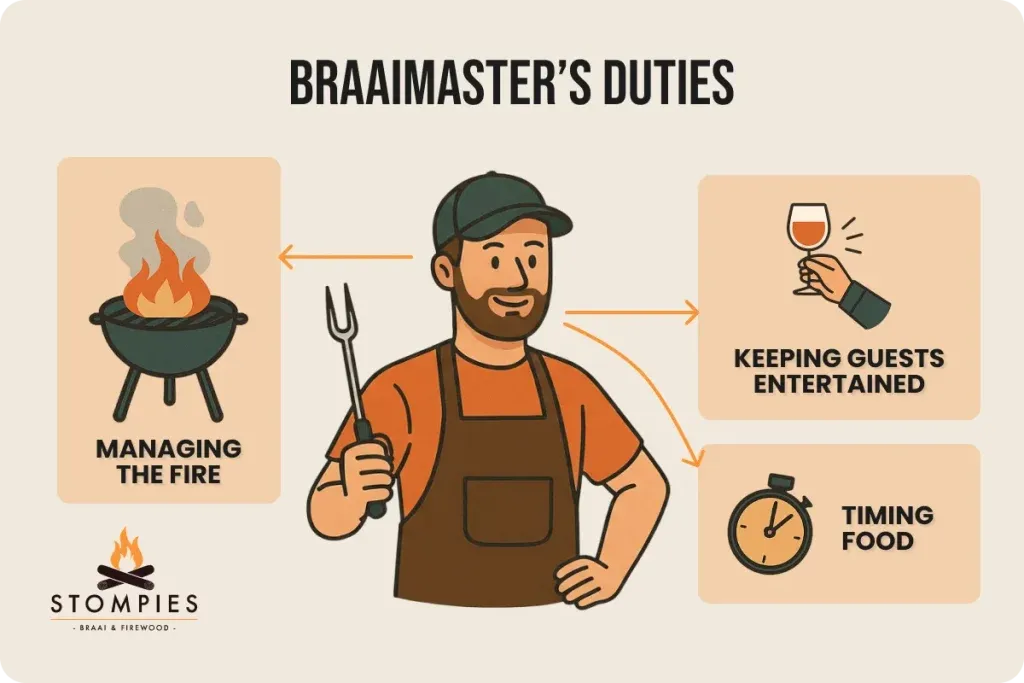
Every braai has one leader: the Braaimaster.
This person controls the flames, manages the timing, and ensures the food is cooked to perfection.
It’s not a title taken lightly.
A good Braaimaster is patient, calm, and confident.
They read the fire like a musician reads a score.
No one touches the grid without their permission.
That’s the golden rule.
Offering advice is welcome if it’s kind, but taking over the tongs is not.
Instead, guests show respect by bringing drinks, offering company, and letting the Braaimaster work their craft.
The Braaimaster doesn’t just cook; they set the tone.
They joke, pour drinks, and keep the atmosphere alive.
It’s leadership mixed with warmth: the embodiment of the South African spirit.
Guests and Good Manners
Guests have their own responsibilities too, sometimes conveniently forgotten (we all know such people).
Arriving empty-handed is never a good idea.
Whether it’s a salad, a pack of drinks, or a dessert, every contribution counts.
It’s not about value but participation: everyone plays a part in the experience.
Patience is essential.
A braai doesn’t run on the clock; it runs on feel.
“Now-now” might mean ten minutes or an hour.
The joy is in the waiting, in the conversations that drift around the fire while the meat sizzles slowly to perfection.
Shared Rituals
Many families have their own braai traditions: a prayer before eating, a first toast, or a specific song that plays every time.
These rituals give each gathering its own heartbeat.
As the fire burns low and the night cools, conversations deepen.
The laughter softens, stories stretch longer, and the glow of the coals reflects the warmth of friendship.
In that quiet crackle lies something sacred: the reminder that the best moments in life are often the simplest.
Respecting the Fire
The fire is the centre of it all.
Treat it with care.
Never waste good wood, never walk away from live coals, and always leave your space clean.
Stompies’ sustainably sourced wood helps keep this respect alive by ensuring that each flame you light is part of a renewable cycle.
A braai without care for its fire loses its soul.
But when handled with love, the fire becomes a living link between past and present: a bridge that connects people through warmth, memory, and smoke rising into the stars.
Planning Your Perfect Braai
Every unforgettable braai begins with good preparation.
It doesn’t have to be complicated; it just requires intention.
Step 1: Preparation and Fire Setup
Choose your spot wisely: open, level, and safe.
Clean the grid, clear old ash, and make sure there’s enough space for guests to gather comfortably.
Begin building your fire about an hour before cooking.
This gives it time to burn down to those perfect coals that make all the difference.
Use Stompies Firelighters for a clean start and build your flame gradually with smaller sticks before adding hardwood logs like Kameeldoring or Rooikrans.
Avoid petrol or chemical starters; they taint both the flavour and the ritual.
Step 2: The Menu
A great braai menu tells a story.
It brings together balance, colour, and flavour while celebrating South Africa’s generous spirit and love of sharing.
The best braais mix familiar favourites with a few surprises, offering something for everyone gathered around the fire.
Start with boerewors, the heartbeat of any South African braai.
Its spiced aroma rising from the grid signals that the feast has begun.
Add steak or chops for those who crave something hearty, thick cuts seared over glowing Stompies coals until the outside is beautifully caramelised and the inside stays tender and juicy.
For variety, include chicken pieces or whole chickens marinated overnight in herbs, lemon, or a touch of peri-peri for a bit of heat.
The steady burn of Stompies briquettes keeps the temperature even, ensuring golden skin and juicy meat without flare-ups.
To add colour and Cape Malay flair, prepare sosaties threaded with onions, peppers, and dried apricots.
Their sweet and savoury glaze caramelises perfectly over the fire, filling the air with that unmistakable South African aroma.
Plan for about 350 grams of meat per person, depending on appetite and sides.
Balance the richness of the meat with classic accompaniments such as pap and sous for tradition, braaibroodjies for comfort, potato salad for creaminess, and chakalaka for spice and brightness.
Do your prep earlier in the day so that when the first spark catches, you can relax, pour a drink, and enjoy the moment.
A real braai is not just about what you cook but how it feels when everyone gathers, laughs, and shares around the warmth of the fire.
Step 3: Timing and Flow
A great braai moves in waves.
The first round of food is often lighter: sausages, wings, or roosterkoek to snack on.
The main meats follow once everyone has settled in.
Keep beverages flowing and music playing to match the pace of the fire.
Allow the event to unfold naturally.
Braai time is social time; there’s no need to rush.
When the main meal ends, place a few logs on the fire, pour another drink, and let the night ease into laughter and storytelling.
Step 4: Safety and Comfort
Weather can change quickly, especially in summer.
Keep an umbrella or gazebo nearby for shade or shelter.
Always have a bucket of water or sand ready for safety.
Once the embers fade, leave the fire to cool completely or cover it with sand before you leave.
Step 5: The Spirit
The perfect braai is not defined by how perfectly the meat is cooked but by how everyone feels when it’s over.
If your guests linger long after the last bite, if laughter still echoes as the coals dim, you’ve succeeded.
As the evening closes, watch the final embers glow.
They are reminders that the best parts of life are built on warmth, connection, and care: values that Stompies upholds in every product it provides.
Common Braai Mistakes to Avoid
Even seasoned Braaimasters can make small errors that affect flavour or flow.
A perfect braai is as much about patience and mindfulness as it is about heat and technique.
Avoiding these common mistakes will keep your fire strong, your food delicious, and your guests happy (or the in-laws).
Rushing the Fire
The biggest mistake is impatience.
Many people start cooking while flames are still licking the grid.
Flames char meat on the outside and leave the inside raw.
Always wait until the fire burns down to glowing coals with a light layer of ash on top.
This steady, radiant heat ensures even cooking.
Quality wood such as Stompies Kameeldoring or Sekelbos burns slowly and evenly, making it easier to achieve the perfect coal bed.
Overcrowding the Grid
A braai grid needs breathing room.
When it’s packed too tightly, food steams instead of searing.
Leave space between pieces so heat can circulate and the smoke can kiss each cut.
If you’re cooking for a large crowd, do it in batches.
It’s better to serve perfectly cooked food in waves than a mountain of meat that’s uneven and dry.
Cooking Over Flames
Flames are dramatic but they ruin food.
If you see flare-ups, move your meat to a cooler part of the grill until they settle.
Small flare-ups are natural, but constant fire under your food means the fat is dripping too fast or your grid is too close.
Patience and positioning are everything.
Forgetting to Rest the Meat
When meat comes off the grill, it needs a moment to rest.
Those few minutes allow juices to redistribute, keeping every bite moist and tender.
Cover with foil and let it breathe before slicing.
The difference in flavour is remarkable.
Ignoring Heat Zones
Every good Braaimaster knows the value of heat zones.
Arrange coals so one side burns hot for searing, the middle stays medium for cooking, and the far edge is cooler for resting or slow roasting.
This gives you control and versatility without ever losing rhythm.
Managing coals from Stompies Rooikrans or Bloekom wood makes this easy, as both maintain even heat across the braai.
Neglecting Safety
A beautiful fire commands respect.
Keep water or sand nearby, make sure the braai is stable, and never leave it unattended.
A calm, controlled fire is safer and cooks better.
Always let your coals cool before disposing of them.
When using Stompies Firelighters or Kindling, remember that clean ignition is as important for flavour as it is for safety.
Overcomplicating the Menu
The magic of a braai lies in its simplicity.
Too many dishes can distract from the essence of the experience.
Choose quality over quantity: a few well-prepared meats, one or two sides, and a few condiments.
Simplicity allows the natural flavours of fire, wood, and smoke to shine.
Forgetting the Social Side
Perhaps the most important mistake to avoid is forgetting that a braai is about people, not performance.
The fire is the centrepiece, but the conversation and laughter around it are what make the memory.
Step away from the grid sometimes, share a story, hand over a drink, and be part of the moment.
Regional Braai Variations Across South Africa
One of the most beautiful things about South Africa is how every province adds its own flavour to the braai.
Each region has its signature wood, preferred meats, and unique atmosphere.
Together, they form a mosaic of tastes and traditions that reflect the country’s diversity.
Western Cape: Coastal Flavours and Cape Malay Spice
In the Western Cape, braai culture is shaped by the ocean and the Cape Malay influence.
Seafood takes centre stage: think fresh fish like snoek brushed with apricot jam or prawns sizzling over Rooikrans wood.
The smoky sweetness pairs perfectly with the salt of the sea.
Sosaties, marinated in curry and dried fruit, are another local favourite, combining savoury and sweet in a single bite.
Here, wine often replaces beer, and the fire burns long into the night under starlit skies.
Northern and Western Regions: The Bushveld Braai
Further inland, the braai becomes heartier and more rugged.
In the Kalahari and Namibian regions, Kameeldoring and Sekelbos dominate for their long-lasting coals and robust aroma.
Large cuts of lamb chops, beef ribs, and oxtail potjies simmer slowly, infusing the air with deep, earthy fragrance.
It’s a place where the fire burns from afternoon into the cool evening, neighbours wander over uninvited, and everyone leaves full and content.
The bushveld braai is the essence of simplicity: good meat, steady heat, and endless sky.
KwaZulu-Natal: The Fusion of Spice and Smoke
KwaZulu-Natal adds a dash of heat and colour.
Here, Indian and Zulu culinary influences combine to create vibrant marinades and bold sauces.
Chicken tikka, peri-peri prawns, and spiced mutton chops often share space on the grid.
The result is a sensory experience that balances chilli, citrus, and smoke.
The even burn of Stompies Black Wattle or Bloekom wood ensures consistent cooking while allowing the marinades and dry rubs to caramelize beautifully.
In coastal towns, seafood is often paired with grilled corn and local chutneys, bringing a festive touch to every meal.
Eastern Cape: Simplicity and Soul
In the Eastern Cape, the braai reflects the province’s unpretentious charm.
The focus is on quality ingredients cooked perfectly.
Lamb and mutton dominate, seasoned with nothing more than salt and love.
Fires built from Bloekom wood burn evenly and cleanly, creating the ideal base for long, patient cooking.
Gatherings are intimate, with families and friends sharing stories while children roast roosterkoek or marshmallows at the edge of the coals.
The simplicity is the beauty: no rush, no fuss, just warmth and connection.
Gauteng and the Highveld: Urban Heat
In South Africa’s busy cities, space is tighter but the braai spirit burns just as strong.
Rooftop terraces and apartment patios often feature compact braais fuelled by charcoal or briquettes.
Stompies Braai Briquettes are especially popular here because they provide consistent, controllable heat that suits smaller spaces.
The urban braai blends tradition with innovation: premium cuts of steak, boerewors sliders, and even vegetarian kebabs make appearances.
Music plays, the skyline glows, and the energy feels alive.
For city dwellers, the braai is a breath of calm in the week’s rush.
Rural Traditions: Where Fire Meets Community
In rural areas, the braai remains deeply communal.
Fires are bigger, meals are slower, and the laughter lasts longer.
Entire villages gather for weddings, holidays, or harvest celebrations.
Massive potjies bubble beside roaring fires, and meat cooks on spits for hours.
Wood combinations like Rooikrans and Black Wattle provide both strength and longevity for these grand gatherings.
Here, the braai isn’t an event; it’s a way of life, passed from elders to children with pride.
Embracing the Spirit of the Flame
To master the art of the South African braai is to understand that it is not just about food but about connection.
Each spark that leaps from the fire carries stories of generations.
Each meal shared around glowing coals becomes part of a living legacy that unites the country across every border and background.
A braai teaches patience and presence.
It slows the world down to the rhythm of crackling wood and warm laughter.
Something I personally think we need more of.
It reminds me that joy doesn’t come from perfection but from participation: from the act of sharing, tasting, and being together.
The type of wood you use, the care you give your fire, and the company you keep all shape the experience.
Stompies’ Namibian hardwoods, charcoal, and firelighters are designed to honour that experience by keeping the flame authentic, sustainable, and strong.
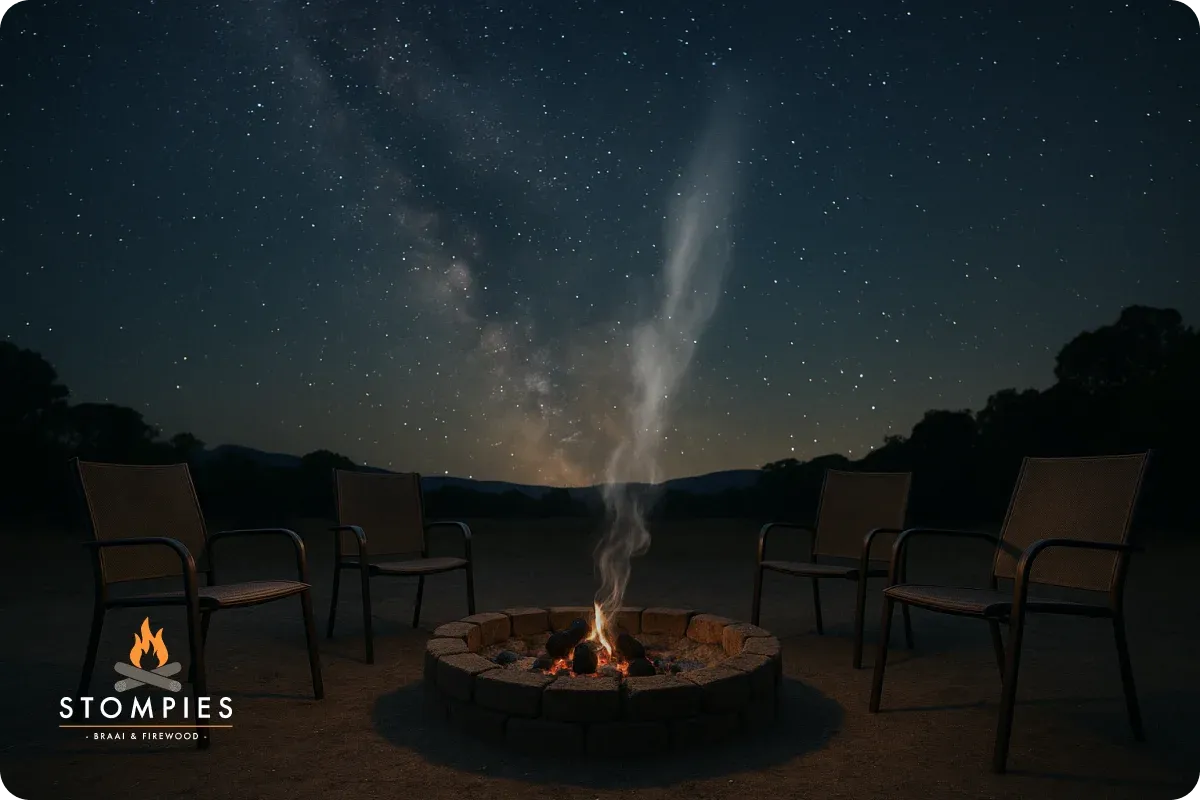
When the night is over and the last embers glow faintly in the dark, there is a quiet satisfaction that lingers.
The air smells of smoke and memory.
The grid is cooling, the plates are empty, and hearts are full.
That is the true magic of a South African braai: the fire that feeds not just the body but the spirit.
Light your fire, gather your people, and let the coals glow.
Because every great story in South Africa begins with one simple thing: a flame.
Ignite the spirit of braai, naturally, with Stompies.
Woods in this guide
Dried, bagged and delivered by Stompies, stacked where you want it.
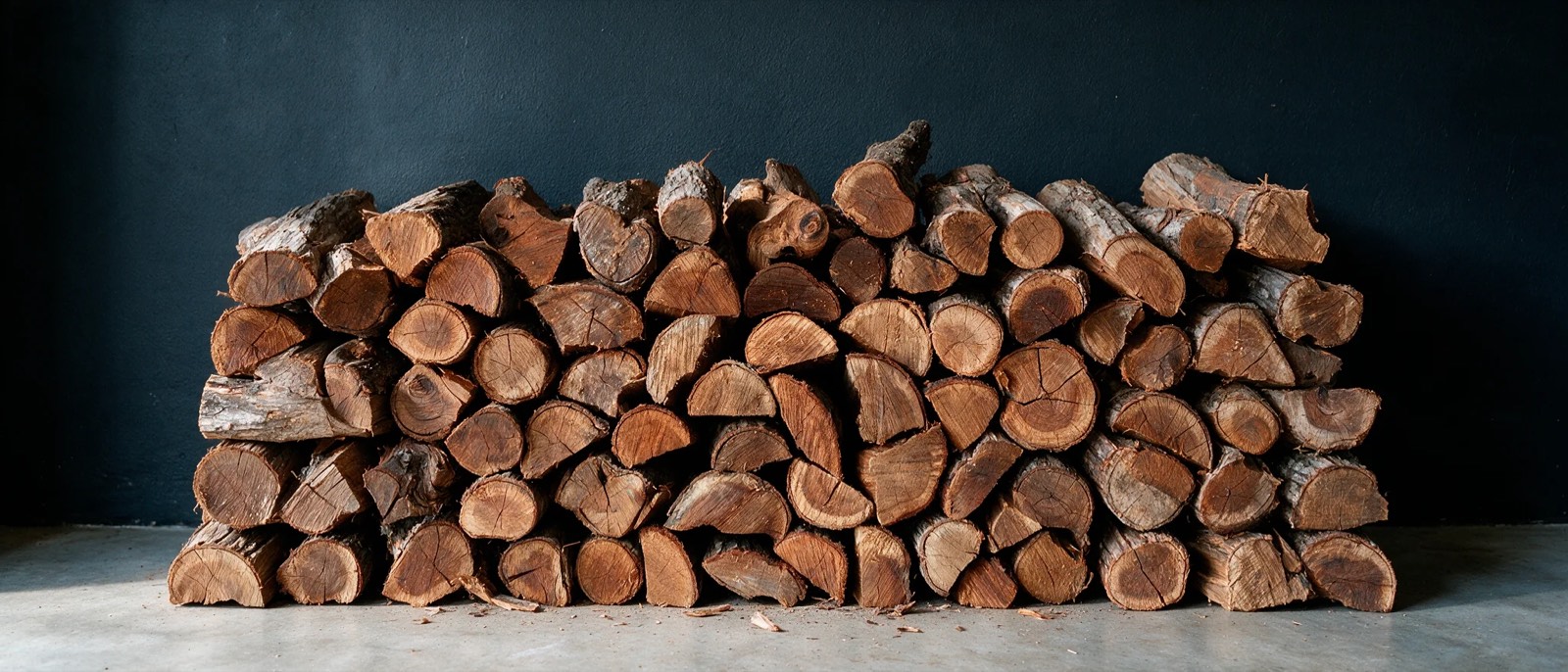 Shop RooikransThe Cape braai wood. It takes a flame without a fight and drops into coals fast, for quick braais: chops, wors, chicken and steak.
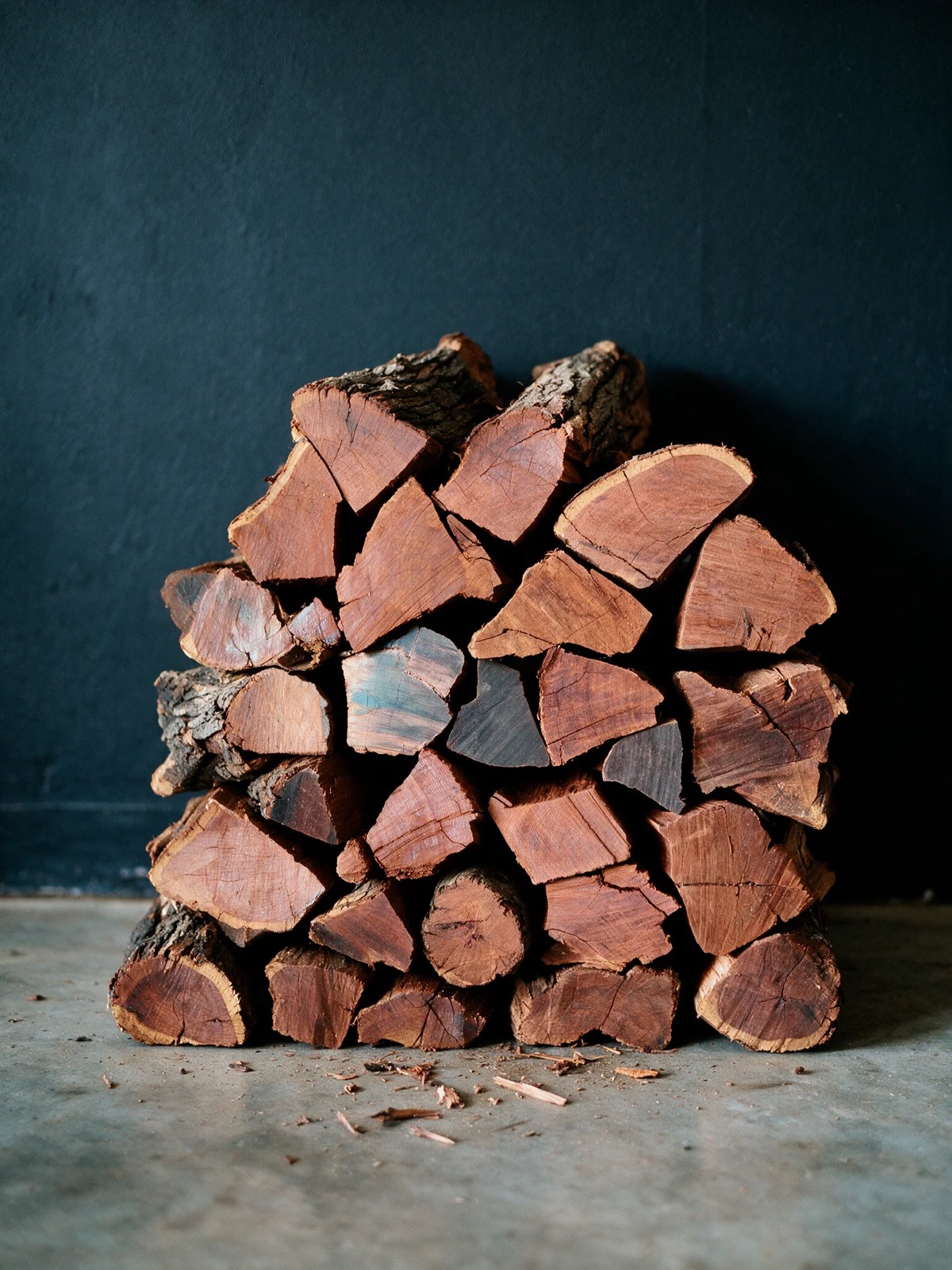 Shop KameeldoringDense Kalahari hardwood for long, slow braais and potjie. Slow to catch, then long, steady heat and coals that keep going.
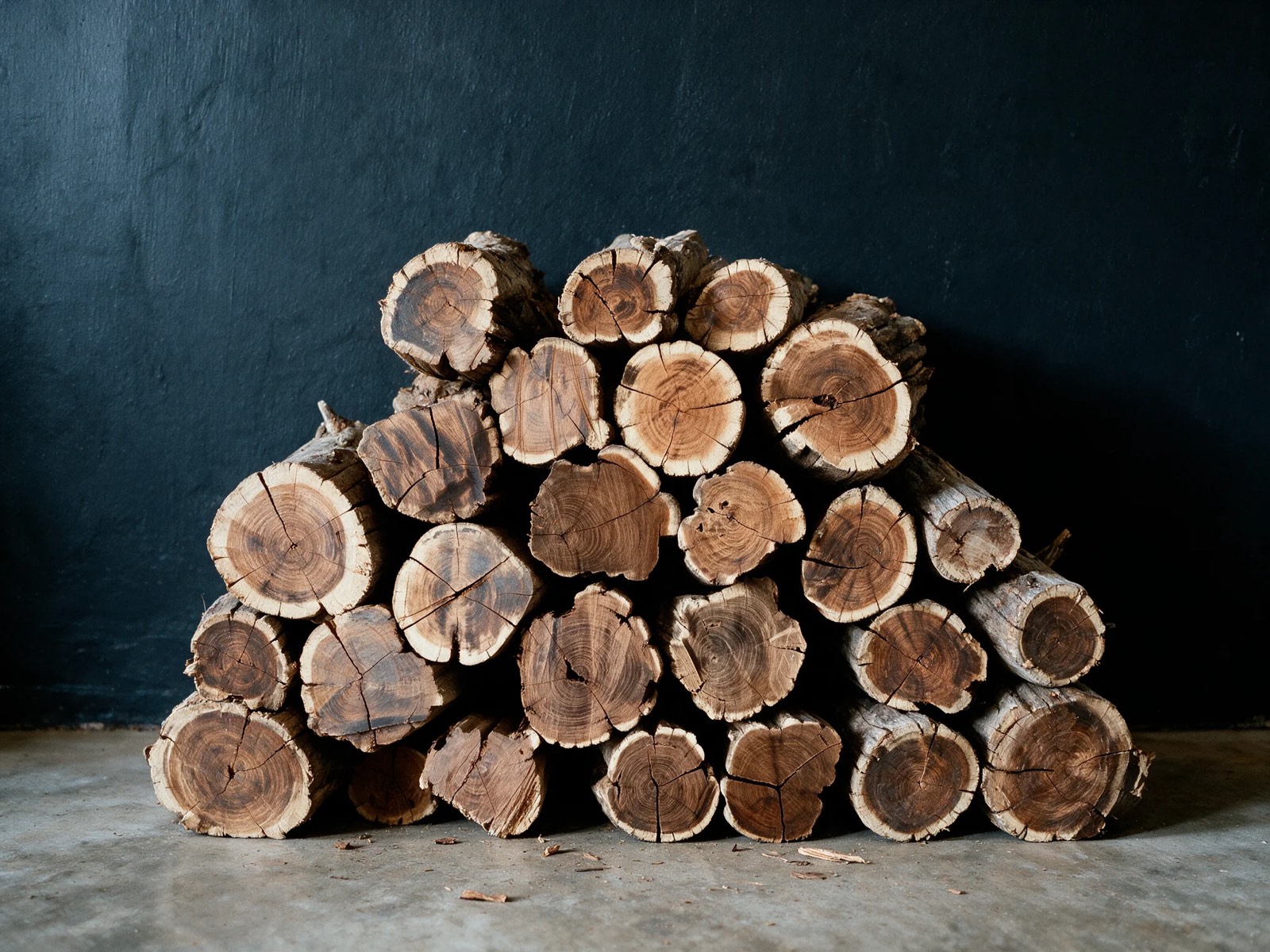 Shop SekelbosDense Namibian hardwood for the braai. It lights readily, burns hot and makes coals that hold, for potjie, thick cuts and anything that needs steady coals.
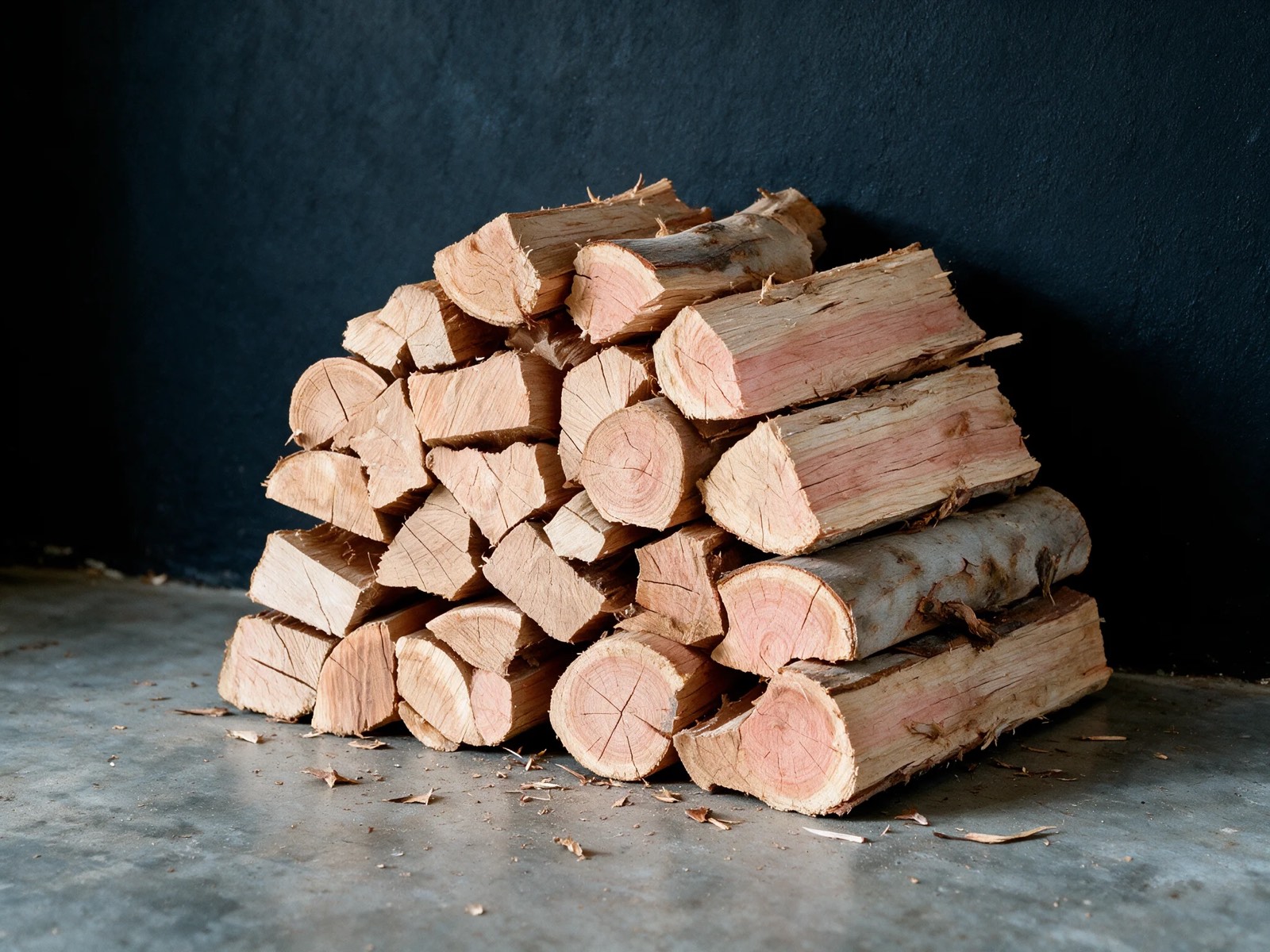 Shop Blue Gum (Bloekom)Our fireplace wood. It lights easily, burns hot and holds its heat between reloads, for the kaggel or closed combustion fireplace all winter.