Closed Combustion Fireplaces: A South African Buyer’s Guide
Warmer rooms on less wood, and heat that lasts past midnight. How to choose from more than 110 closed combustion models, with the flue and installation priced in.
 The Stompies teamUpdated 8 min read
In this article
- 1What is a closed combustion fireplace, and how does it work?
- 2Closed combustion vs open fireplace: which is better?
- 3What size closed combustion fireplace do I need?
- 4Freestanding, built-in, wall-mounted or insert?
- 5Cast iron or steel?
- 6What does the flue and installation involve?
- 7What wood should you burn in a closed combustion fireplace?
- 8Should you consider a pellet heater instead?
- 9How do you buy a closed combustion fireplace from Stompies?
By the team at Stompies Wood. Specifications as at September 2026.
A closed combustion fireplace burns wood behind a sealed glass door, with air vents that control how fast it burns. That control is why it heats a room an open fire never will. Get three things right and you’ll buy well: the kW for your floor area, a format that fits your wall, and a flue that matches the unit.
We sell more than 110 wood-burning closed combustion models across Invicta, Odyssey, Modena, Verona and the L-series built-ins, and we deliver the dry wood that goes in them. This guide is what we’d tell you if you asked us.
What is a closed combustion fireplace, and how does it work?
It’s a sealed firebox with a glass door. Primary air feeds the fire from below. Secondary air enters higher up, burns off the gases a smoky fire would send up the chimney, and washes across the glass so you can still see the flames. You turn the vents down and the fire slows. You open them and it picks up.
Heat reaches the room two ways: radiated through the glass and the body, and given off by the flue pipe as it runs up through the room.
The difference in efficiency is written into law in Europe. Since 1 January 2022, an open-fronted solid fuel heater sold in the EU must reach at least 30% seasonal efficiency, and a closed-fronted one at least 65%, under Commission Regulation (EU) 2015/1185. The wood-burning models in our range list efficiencies of 70% to 87% on their manufacturers’ specification sheets, with a median of 77%, as at September 2026.
Closed combustion vs open fireplace: which is better?
For heating a room, closed combustion wins, and it isn’t close.
| Open fireplace | Closed combustion | |
|---|---|---|
| Minimum efficiency to be sold in the EU | 30% | 65% |
| Control over the burn | None. It burns as fast as it likes | Air vents set the pace |
| Wood per evening | More, for less heat | Less, for more heat |
| Smoke and sparks in the room | Can happen when the draw is poor | Kept behind the glass |
| Overnight heat | Gone by midnight | Some models are rated for 8 hours on a slow burn |
The open fire still wins on one thing: sound and smell. If you want the crackle more than the warmth, keep the open fire and braai in it. If you want a warm house in July, close it up.
Keep the door shut once the fire is going. The US Environmental Protection Agency warns that an open appliance door can release carbon monoxide into your home. Fit a carbon monoxide alarm in the same room as any wood-burning appliance.
What size closed combustion fireplace do I need?
Start with floor area, not looks. Every model has a rated heat output in kW and a heating area range in square metres. Across our range, the manufacturers’ figures work out to roughly 1 kW for every 9 to 11 m² at the middle of each range.
| Floor area to heat | Output | Examples from our range |
|---|---|---|
| 30 to 70 m² | 5 to 6 kW | Invicta Ovatio, Parma L, Odyssey 45 |
| 50 to 115 m² | 7 to 9 kW | Invicta Aratos, Toledo, Invicta Brio Direct Air Supply |
| 60 to 136 m² | 9.5 to 11 kW | Invicta Le Modena, Odyssey 70 |
| 75 to 160 m² | 11.3 to 13 kW | Invicta Preston, Invicta Elton, W7 Bavorov Wall |
| 85 to 220 m² | 14 to 18 kW | L9 Titan, L11 Vulcan, Flat Minimal 125 |
Heating areas and outputs are the manufacturers’ figures from our product pages, as at September 2026.
Then adjust for the house you actually live in. A double-volume lounge, a wall of glass or an old stone cottage with a draughty floor needs the top of the range, or the next size up. A well-insulated new build sits comfortably in the middle.
Don’t oversize. A unit that’s too big for the room has to be throttled right down to stop you cooking. A starved fire burns cool and dirty: it blackens the glass, and it coats the flue with tar. Buy for the room you have, not the room you might build one day.
Freestanding, built-in, wall-mounted or insert?
That’s mostly about your wall and your floor plan.
- Freestanding. Sits on a hearth in the room and throws heat from all sides. The easiest to install where there’s no existing chimney. See our freestanding models.
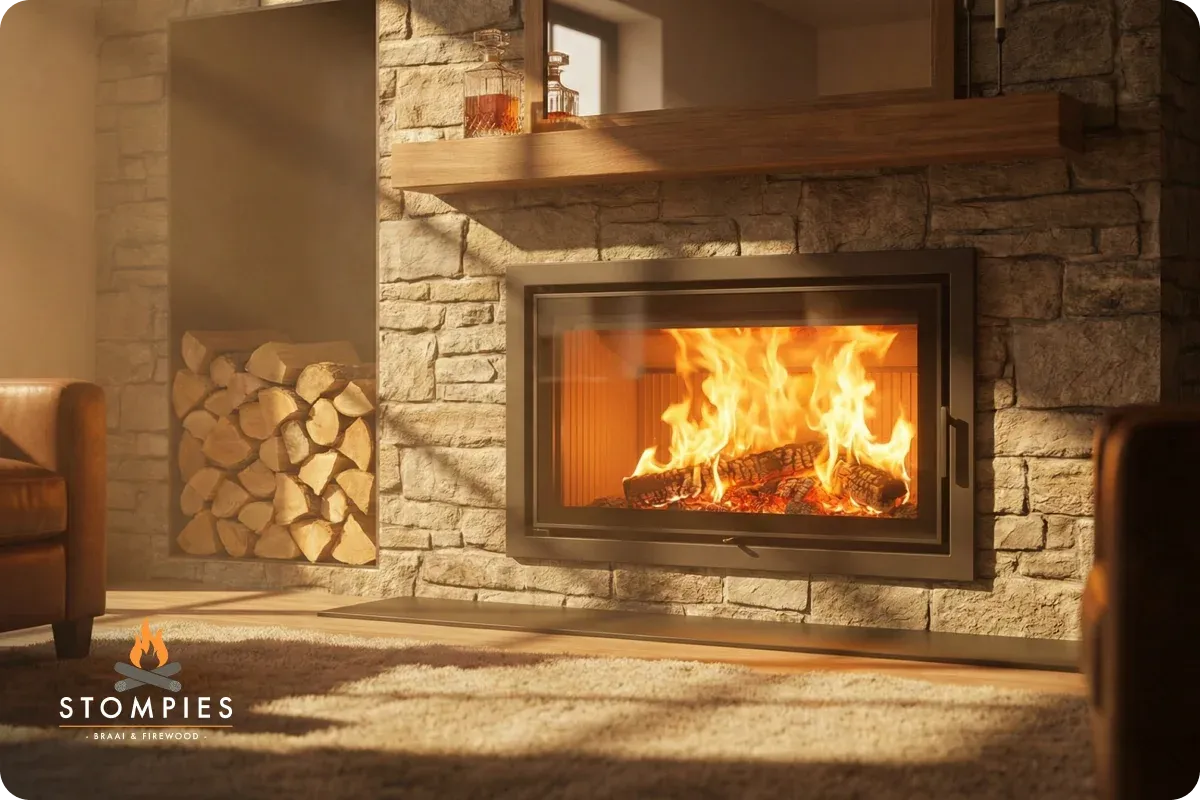
- Built-in. Set into a chimney breast or a cladded surround, so only the glass front shows. Cleaner lines, more building work. See our built-in units.
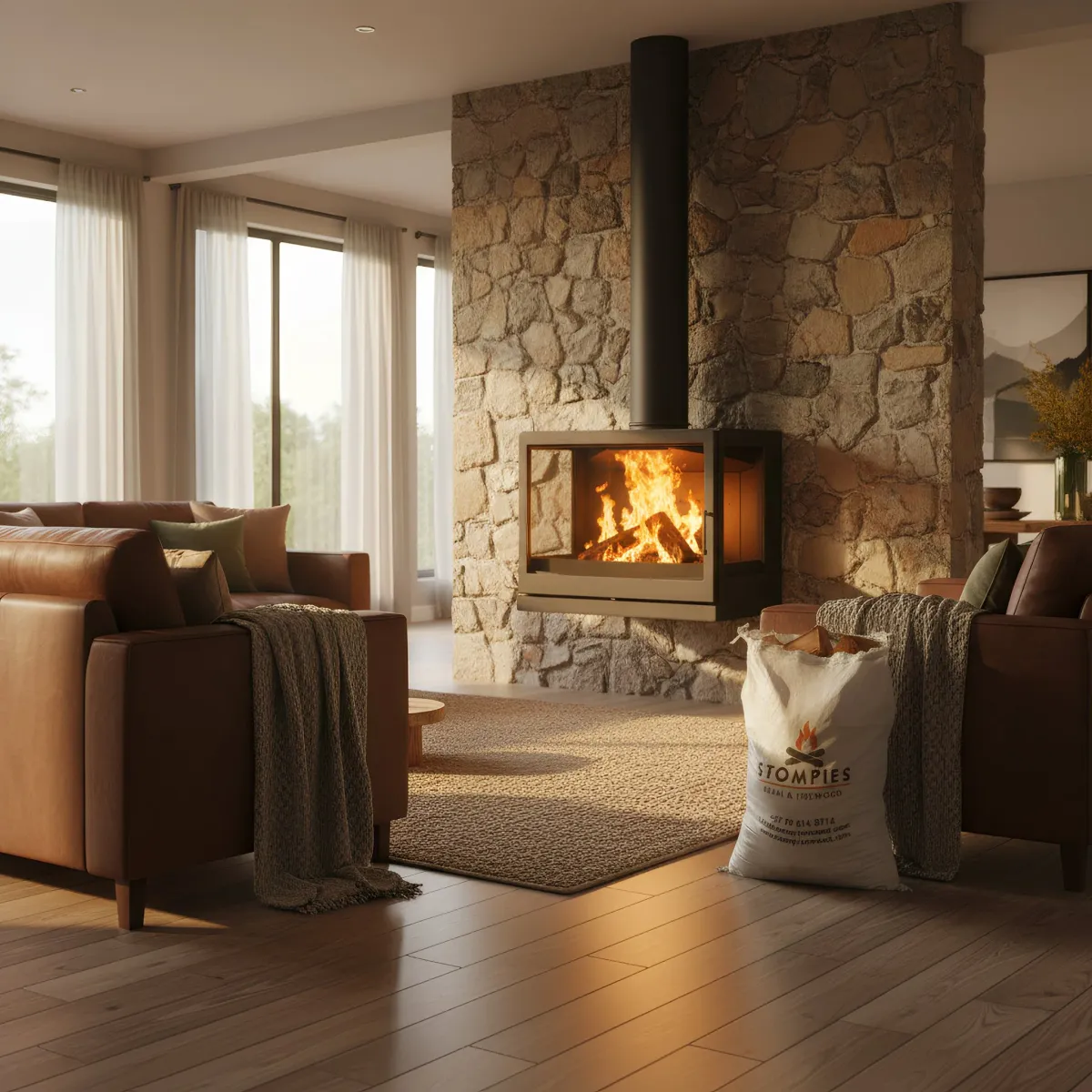
- Wall-mounted. Hung on a wall, which frees up floor space in a smaller room. See our wall-mounted fireplaces.
- Double-sided. Glass on both faces, so one fire heats two rooms or both sides of an open-plan space. We carry 12 double-sided models.
- Insert. Made to go into an existing open fireplace. It’s the usual way to convert an open fire to closed combustion. The TEIDE 80 Insertable, and the Merida DF and Algora DF fan inserts, are built for this.
For the deeper trade-off between the first two, read our freestanding versus built-in comparison.
Cast iron or steel?
Of the 112 wood-burning models with a full specification sheet, 63 are cast iron and 49 are steel. Neither is better. They behave differently.
Cast iron takes longer to warm up and keeps giving off heat long after the fire has died down. It suits a house that burns every evening all winter. It’s also heavy: the Invicta Elton weighs 210 kg.
Steel heats up faster and cools faster. It suits a weekend cottage, or a room you want warm quickly after work. It’s lighter too: the Toledo is 80 kg and the Parma L 44 kg.
Weight matters more than people expect. On a suspended timber floor or an upper storey, have your installer check the floor will carry the unit and its hearth before you choose.
What does the flue and installation involve?
The flue is half the fireplace. It carries the smoke out, pulls in the air the fire needs, and gives off a good share of the heat on its way up.
Match the flue to the outlet. Flue diameters across our range run from 123 mm to 250 mm. The most common are 180 mm (35 models) and 150 mm (33 models). Some models vent from the top, some from the rear, some either way. An existing chimney has to suit the new unit, or it needs a liner.
South Africa’s building standard sets the basics. SANS 10400-V, the national standard for space heating, requires that any space heating system “be so designed, constructed and installed as to operate safely” (regulation V1(1)). Among its deemed-to-satisfy rules:
- The chimney outlet must be at least 1 m above the highest point where it meets the roof, or at least 600 mm above the ridge when it sits within 600 mm of a ridge on a roof pitched at 10° or more (clause 4.3.6).
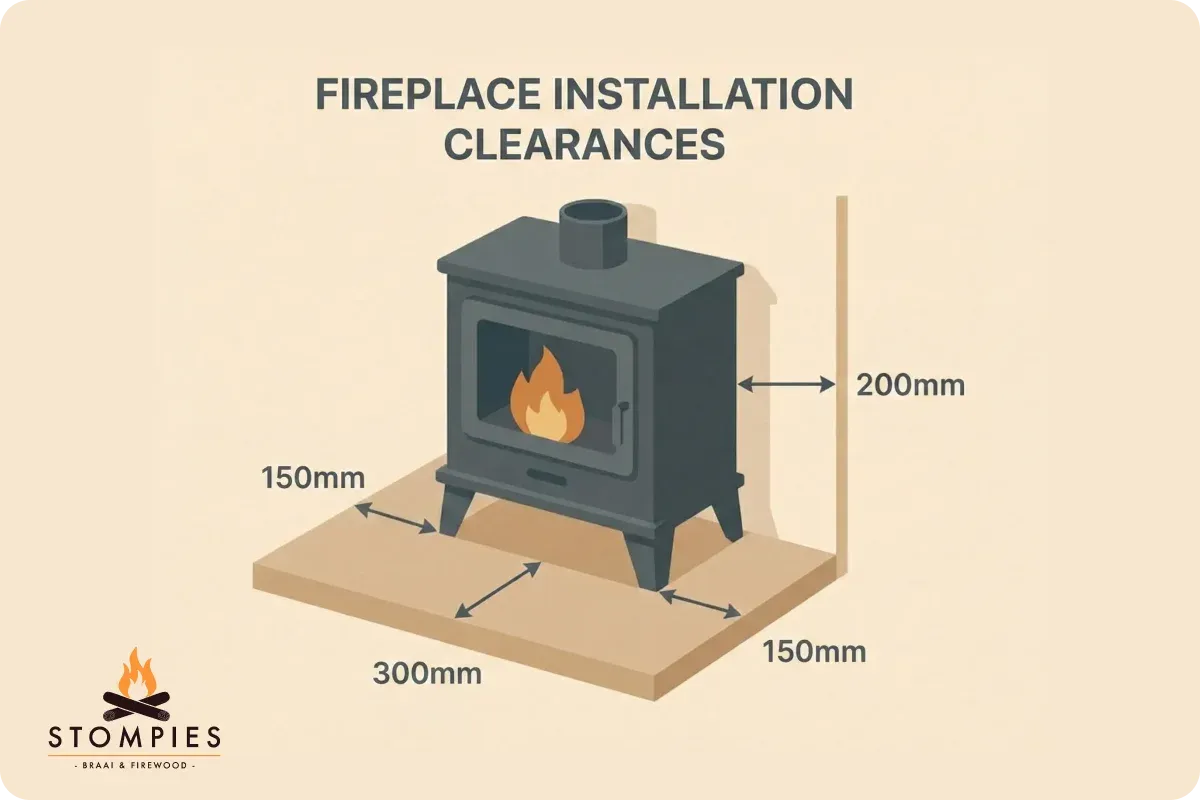
- The hearth must extend at least 500 mm in front of the grate or fire basket and 300 mm beyond each side (clause 4.4.2), with no timber joist or other combustible material built into it (clause 4.4.3).
Your installer also works to the manufacturer’s clearances for the specific model. Ask them to confirm with your municipality whether the work needs plan approval.
If your house is well sealed, look at outside air supply. Eleven models in our range can take their combustion air through a duct from outside instead of from the room, including the Invicta Brio, the Invicta Elo M and several L5 Strasbourgh and L51 Nova units. That stops the fire competing with you for air in a tight modern house, and it cuts the cold draught a room-fed fire pulls in under the doors.
For more on the building work itself, read our installation tips for South African homes.
What wood should you burn in a closed combustion fireplace?
Dry wood, every time. A sealed firebox is less forgiving than an open grate. Wet wood spends its heat boiling off water, smokes, blackens the glass and lays tar in the flue. The US Environmental Protection Agency says wood burns best below 20% moisture content.
Smoke is also a legal matter in Cape Town. The City’s Air Quality Management By-law prohibits dark smoke from any dwelling for more than three minutes in any 30-minute period (section 18(1)). Dry wood in a properly flued unit keeps you on the right side of it.
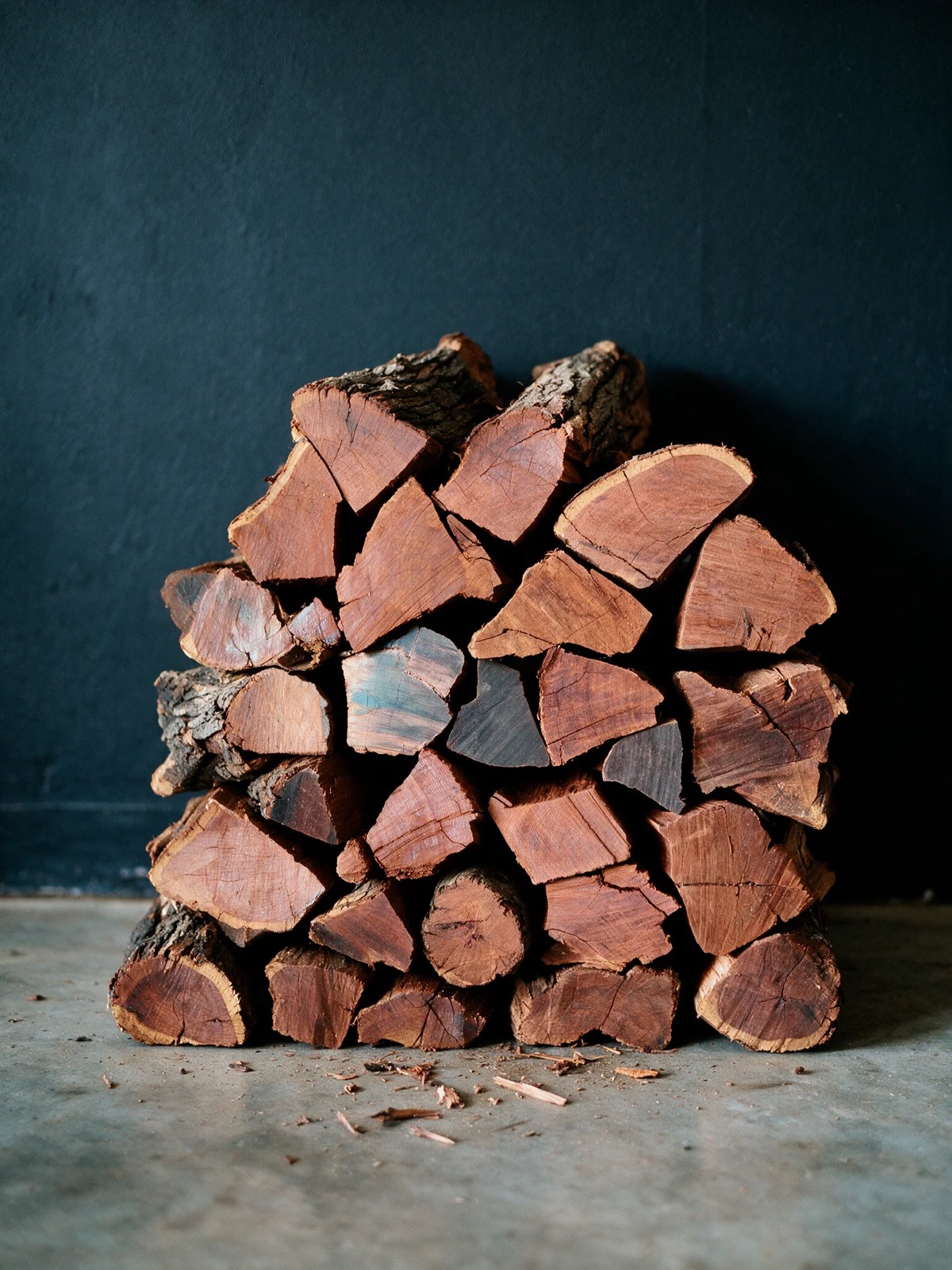
After dryness, density decides how long a load lasts. Every one of our bulk bags weighs 15 kg, whatever the species, so a denser wood gives up its heat more slowly from the same weight. According to The Wood Database, Kameeldoring (Camel Thorn) has a dried density of 1 185 kg/m³ against 730 kg/m³ for black wattle, both at 12% moisture. That’s why kameeldoring is the wood for a long, slow overnight burn.
For the full species comparison, see the woods that burn longest in a fireplace. When you’re ready to stock up, our dry fireplace wood comes with the Dry Wood or Buyback Guarantee, delivered to the stoep across the Western Cape, including the Garden Route, and Gauteng.
Before you buy, check the maximum log length on the fireplace’s specification sheet. A firebox that takes 50 cm logs is easier to feed than one that takes 30 cm.
Should you consider a pellet heater instead?
Only if you want heat on a timer more than you want a fire. A pellet heater feeds itself and holds a set temperature. It also needs electricity for the auger and fan, so it goes dark in a power cut unless it’s on backup power. A wood-burning closed combustion unit doesn’t need power at all. If a pellet heater suits your routine, see our pellet heaters.
How do you buy a closed combustion fireplace from Stompies?
Our fireplace product pages don’t list a price, and that’s deliberate. The unit is only part of the job. The flue, the hearth and the installation depend on your house, so a price without them would be a guess.
Send us three things: the floor area of the room, the format you have in mind, and a photo of the wall or corner. Use the enquiry form or the WhatsApp link on our full fireplace range page. We’ll phone you with the models that fit the space, and a quote that includes the flue kit and installation.
The wood in this guide
Dried, bagged and delivered by Stompies, stacked where you want it.